
Gallery
Maxmilián Pirner (1854-1924)
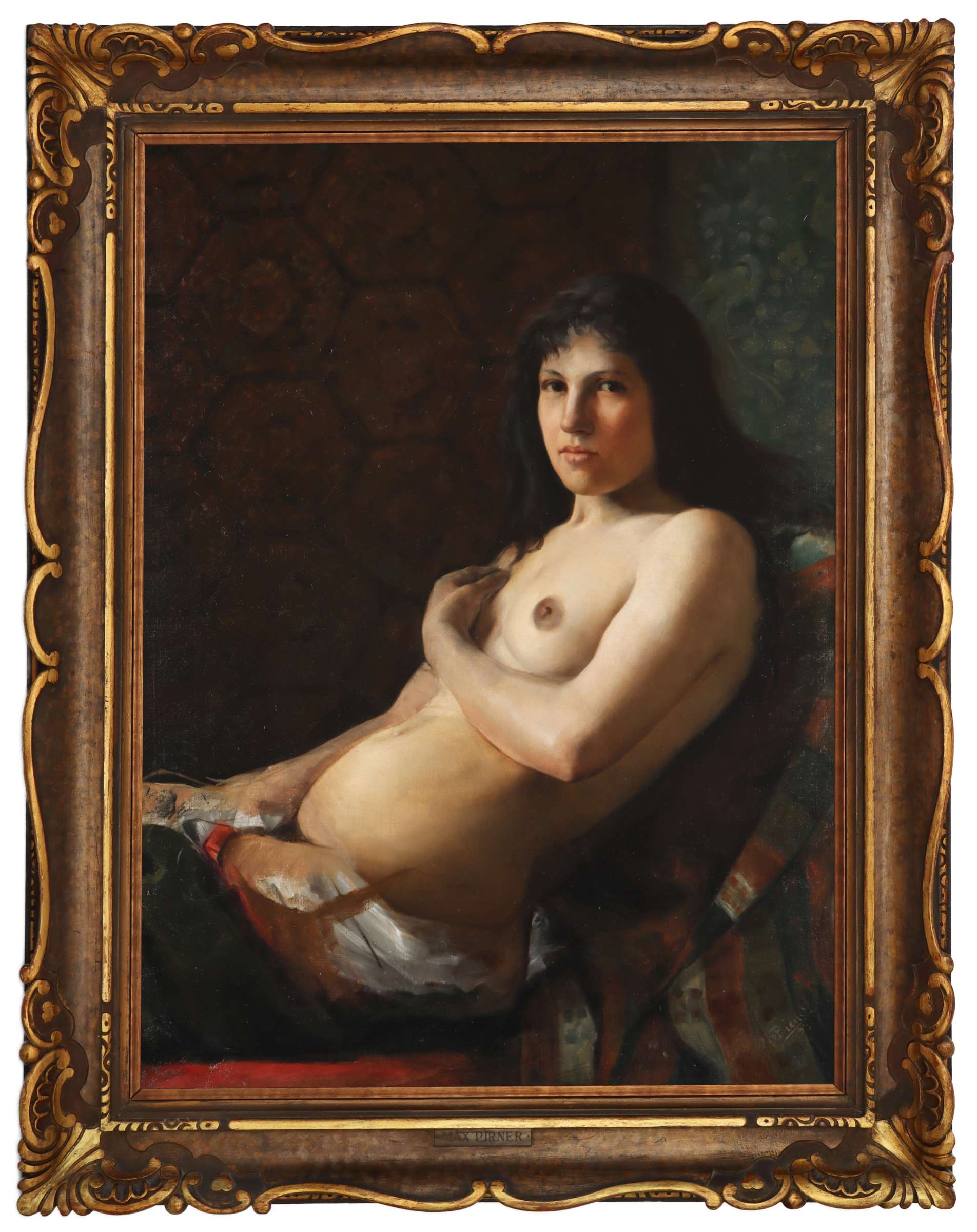
Černá Káča (Black Káča), 1893, oil on canvas, signed and dated lower right M. Pirner 93, painting dimensions 93 × 69 cm, original mounting, overall dimensions including frame 114 × 90 cm.
Expert report: PhDr. Rea Michalová, Ph.D.
From the report:
The assessed painting “Černá Káča” is an original, top-tier, and highly captivating work by Maxmilián Pirner, professor at the Academy of Fine Arts in Prague, one of the most important artists of the late nineteenth and early twentieth centuries, a representative of European late Romanticism and a member of the second tier of the National Theatre generation. He postulated an art that was not dependent on the direct observation of reality. His combination of Neo-Romantic poetics with mysterious, post-allegorical visions is unique and makes Max Pirner one of the central initiators of Czech painterly Symbolism.
As Roman Prahl aptly stated, Pirner “both independently ‘modernized’ allegory by unusually combining elements of classical mythology and personification, and in some works intensified multivalence reaching beyond conceptual discursiveness, employing the direct suggestiveness of forms, light, and colors in the direction of modern visual symbolism.” At the same time, Pirner was probably the most significant representative in the Czech context of a current developing worldview pessimism and the Neo-Romantic sacralization of art according to Arthur Schopenhauer. He “updated the dualistic conception of traditional idealism with regard to art.” He emphasized the threat to eternally valid Art posed by the onslaught of the secular and the transient in the modern world, an attitude close to the conservative current of Symbolist art (R. Prahl).
The assessed painting “Černá Káča” presents Maxmilián Pirner as a masterful figurative painter whose work was nourished both by Neo-Romantic imagination and by profound erotic inspiration, which this work demonstrates superbly. The classical method of painting from a model enabled the “saturation” of the idea with a living perception. Max Pirner was literally fascinated by Černá Káča, whose real name was Kateřina Michalová, a professional model at the Academy of Fine Arts, the most sought-after and best-known personality in her field. This femme fatale, with long raven-black hair, a captivating gaze, and an overall southern appearance, passed through the lives and works of a number of important artists: besides Max Pirner, who portrayed her several times and whose multi-figure compositions also feature her likeness, she was also depicted by Václav Brožík, Josef Václav Myslbek, and Max Švabinský.
In the assessed painting “Černá Káča,” the artist’s interest in distinctive painterly means is splendidly reflected—attested by the brilliant, highly self-assured execution, in which an emphasis on precise detail is sophisticatedly confronted with thoroughly modern elements of so-called non finito. In this painting of great collectible value, Maxmilián Pirner succeeded in ingeniously uniting two great artistic traditions—Makartian naturalism and Mánes-style lyricism.